


Why can’t we agree to drill and decarbonize at the same time?

Corporate leaders managing complex enterprise and market risks consistently trump popularized bent truths with principled and pragmatic solutions. Such leaders don’t choose to operate in a world of limiting values or constraints. They lean into present uncertainty and foretell future opportunity with courage and confidence.
In the past few years, a one-sided, command and control, winner takes all rhetoric has become an earmark of the American brand of politics. Business concerns ranging from the use of AI in the military, to how corporations should amend policies that impact on the culture of their workplace and employees, to whether businesses should or should not openly discuss their material social and environmental risks represent clear and present overreach that plays out each day.
For an Administration that wants to streamline regulation, there certainly are a lot of new rules that corporations are expected to follow, whether they are implicit or enforced. Mantra’s like “drill baby drill,” or the military’s AI “will not be woke,” attempt to maneuver if not outright manipulate free markets. However, as evidenced by the rapid run-up in oil prices since the February 28th Iranian conflict, markets are real, they are complex, and they correct themselves when they are inefficient. Markets don’t flow to the beat of whimsical fantasy.

The flaring American brand of politics has become concerning, not (only) because it is arguably arrogant and abhorrent, but because it undervalues [global] market risk and volatility and overestimates the alignment of resources for delivering quality of life while advancing innovation. Look no further than “drill baby drill” as a narrow-minded and limiting strategy. When this is coupled with a de-emphasis on decarbonization policy and practical pathways, the net result is that energy market, supply chain, economy-wide, and environmental risks are not effectively managed or mitigated. Rather, such risks are heightened and become more pervasive.
This is not an argument for or against drilling or decarbonizing. This is a call for what I term “planet pragmatism,” an approach that enlivens cohesive, structured, and collaborative dialog and decision making on behalf of principled leaders who understand their charge and the need for common sense for the common good solutions.
Foiled by our Spoils
Oil and gas have dominated global energy supply and market demand for over 150 years. The global economy runs on molecules, and increasingly more on electrons. An idea of a well-balanced portfolio, for personal investments, for private equity companies, for ecology and the natural environment, or for your favorite sports league has consistently proven to deliver performance, mitigate risk, and yield positive impact. Thus, it is only reasonable and logical that business and society pursue “common sense for the common good” approaches to energy supply, demand, market cohesion, and innovation.
For better or for worse, we live in a two-phased world where we have one foot placed firmly in the present, supporting infrastructure that was devised by best-in-class technology and processes of years past. In doing so, we maintain and work with what we have in the most efficient and productive manner possible. And then there is our other foot, inching toward the future, wanting to improve upon the design and operations of the past with advanced technology, and a desire to bring humanity forward, toward a higher purpose and a greater prosperity for all. This duality inherently produces tension, in politics, business, government, and within civil society.
However, when we choose to value and communicate the dynamic of this duality in productive ways, we can align today’s necessity with future purpose in a principled way – allowing for pragmatism to shine through our decisions, as opposed to polarizing doctrines that typically only serve to incite fear, frustration, anger, or distrust among stakeholders. Consistent, clear, cohesive, and collaborative communication is severely lacking in our current situation. This is a leadership gap, one that creates market uncertainty, civil distrust, and a complicit culture.

Quiet Companies are not Complicit Companies, they are Covert Strategists
The persistent and pragmatic pursuit of sustainable enterprise is continuing to evolve, albeit in stealth mode, particularly for America’s largest corporations. Prior to the political sea-change that occurred following the 2024 election, clean and renewable energy infrastructure was not only a hot investment, but it was also a foundation to federal, state, and corporate strategy for modernizing our infrastructure and decarbonizing the industrial economy.
But since the 2024 election and amid fears of political backlash, public shaming, and shareholder pressures, the CEOs of many energy-intensive industries have toned down their once progressive stance on a “whole of industry” approach to decarbonization. So, it seems, political rhetoric has forced the hands of corporate power to be what appears to be a mass acquiescing of ideology. Power, rules, money, and technology legitimately “run the world,” yet they also oversimplify the ground rules of how our economy operates. Pragmatic executives understand that an economy operating on $100/barrel oil will not be self-reliant or resilient in the long-term. While the Washington power dynamic wants to shift ideology and rules, the reality is that the bill will come due, as it always does, no matter what Administration is in office.
Enter the Secret Sustainability War Room
Make no mistake, American company executives are not completely tone-deaf when it comes down to the necessity to design, build, operate and maintain resilient infrastructure. In fact, announcing their 2026 “Climate Insights” report, Keith Creel, President and CEO of the North American rail giant, Canadian Pacific Kansas City (CPKC) recently stated[i], “…these reports showcase CPKC’s dedication to responsible growth and leadership in climate action, reflecting our vision for a more sustainable rail network across North America through innovation and environmental stewardship.”
Corporate CEO’s, Boards, employees, trade associations, advocacy groups, community groups, and other stakeholders that are vocal about how they evaluate, mitigate, and manage material business (and associated societal) risks including climate, through innovation and stewardship, are not deranged, contravening, or tyrannical. They are principled and pragmatic, demonstrating a higher intelligence and developed skill set that is forthright and steadfast, and adaptive and inclusive. Such leaders represent the necessary acumen required to carry us [society] forward, while being deeply rooted in what is needed to get the job done today.
Savvy political chameleons with a long-term market outlook and competitive spirit – smart, strategic, and principled executives have been supercharging their “sustainability war rooms.” Within the quiet sanctuary and covert cover of their corporate mansions, pragmatic executives have already, without pontification or chicanery, assembled the best and brightest to chart their course for long-term growth, innovation, and impact. While these sustainability freedom fighters may not be using the “s-word” publicly, they know that their future, and that of their enterprise, is intrinsically tied to their ability to innovate, grow, and lead.

Accordingly, future-looking options, such as decarbonization, that optimize the use of natural resources, reduce operating costs, reinforce resilient operation, and mitigate against financial, environmental, and other material risks remain valid strategies that remain on the table. Modern business is facing an unprecedented level of asymmetric risks. Smart executives understand that being overtly headstrong when political headwinds are high is foolish. They understand that the future is not built on simple-minded singular technologies or strategies.
Rather, they operate under the known conditions of today as they innovate for the future. Thus, they guide their teams to employ a preventive, predictive, and proactive posture on the future of their enterprise. In doing so, political placation yields to planet pragmatism – the idea that in the current state of the global economy and societal affairs there is necessity and cause for both drilling and decarbonizing simultaneously. Given the state of our economy, society, and environment we must learn to live with one foot planted in the present and one foot stepping cautiously and yet eagerly into the future. That’s just logical and prudent.
Advancing Principled and Pragmatic Leadership in an Era of Senseless Coercion
The pressurized and hyped reality we are living in may not align with our political, spiritual, ethical, moral, or economic convictions or goals. Yet, deep down, we know, as the smart intuitive CEOs know, that when markets are inefficient, they will be corrected, and eventually resources and goals will become more aligned. The global economy is imperfect, just as American politics is imperfect. But we need to stop giving credence to the idea that there are singular ideas, technologies, leaders, companies, or solutions that create greatness for all.
Prosperity is under assault. Consistently and reliably, the power of business and free markets has been a force that benefits the common good, especially when they are led by principled leaders which provide the necessary oversight, stewardship, foresight, and correction when they are needed most. There should be no debate over drilling and decarbonizing, and whatever else may fill the airwaves of hot button one-sided issues that feel like soulless and senseless attempts at mass coercion from all sides. To move forward, we need leaders that can convene, build cohesion, and move beyond a winner takes all dogma. This is a precarious moment when principled leaders are needed the most.
* * *
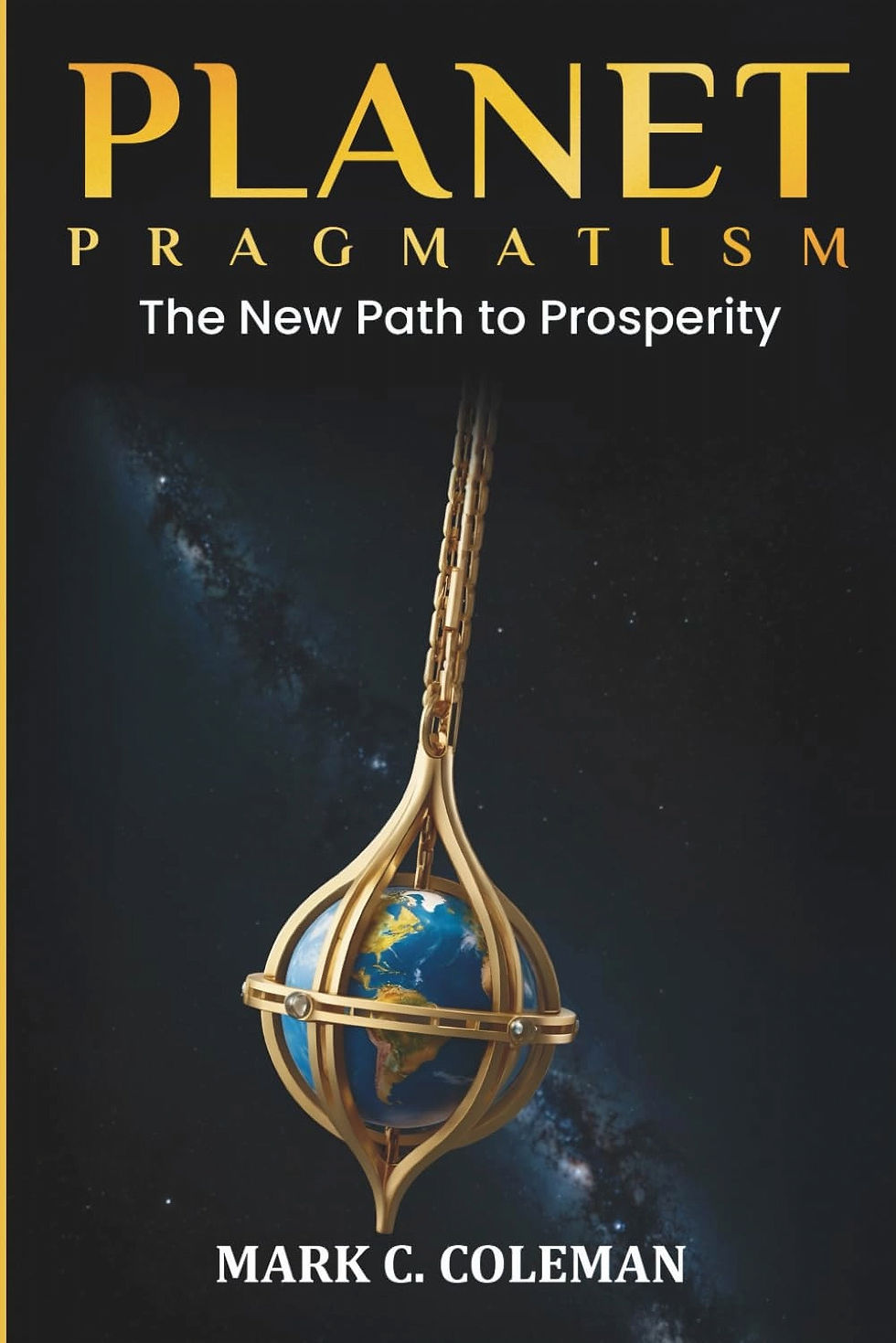
Enjoy this post? Check-out Mark's new book, Planet Pragmatism: The New Path to Prosperity
[i] Source: Progressive Railroading. March 23, 2026. “CPKC issues 2026 climate action reports.” https://www.progressiverailroading.com/canadian_pacific_kansas_city/news/CPKC-issues-2026-climate-action-reports--76605



Comments